|
February 6th, 2012
Backup Power for Your Home
You rely on many appliances and systems in your home for your health, comfort and security. Most depend completely on utility-supplied electricity. It makes sense to have a backup system that will keep your family comfortable and your home safe in a power failure.
This fact sheet has 10 tips about backup power systems. Following the tips, six basic types of backup systems are described in Table 1.
1 — Plan
Careful preparation is essential to select, buy and install a backup system. Don’t leave it to the last minute — your household should have time to learn how to use the system in advance. And during a power failure, you may not be able to find suitable, reasonably priced equipment, fuel, and/or installation help. Keep the system simple, so you and your family can operate and maintain it. Your emergency system must work reliably when needed.
2 — Depending on the Season, Keep the Heat In (or Out)
During winter months, the main purpose of a backup system is to keep the house warm (and sometimes to keep the basement dry). You have to be able to keep the heat in, prevent unnecessary air infiltration and prevent pipes from freezing. The starting point is proper insulation and air sealing, before you consider your backup power needs.
In summer months, the main purpose of a backup system for Canadians is to keep the house from becoming too warm. People who have difficulties with extreme heat (seniors, asthmatics, and so on) especially need an alternative plan to power their homes. The starting point is proper insulation and shading. External blinds or shutters can help.
3 — Change to Energy-Efficient Appliances
Your backup system will do the most good if it is powering efficient appliances. Check if there is an EnerGuide label to determine each appliance’s power consumption, or use an electrician’s ammeter to find out how much power each appliance uses — its current draw in amps. Ammeters can be purchased in a hardware or electrical supply store.
The energy requirements of some appliances will surprise you. Replace the inefficient appliances with efficient models. Change to energy-efficient light bulbs like compact fluorescents. When buying new equipment, get the most efficient possible — for example, an Energy Star® qualified refrigerator or a lower-volume, smaller horsepower well pump or sump pump.
Make sure your furnace-fan motor is the most efficient available. If you are replacing your heating system, choose a furnace with a variable speed motor and an AFUE (Annual Fuel Utilization Efficiency) rating of 90 or more.
Consider switching your water heater to gas or propane. Add a solar water heater to your existing fossil-fuelled or electric water heating system. A solar heater works in tandem with your conventional system to reduce your daily energy consumption. Some solar water heating systems make use of a small 15 – 20 watt photovoltaic (PV) solar panel to power the circulating pump, so they will operate normally in a power outage. A properly sized solar water heater can provide about 50 per cent of your annual water heating load; and 80 – 100 per cent of your load in the summer months ($3,000 – $4,000 installed cost).
Remember: when you use a backup system you must manage your electrical load. You will have to operate even your most efficient appliances wisely, so that you have essential power as long as possible.
You may wish to purchase good quality surge protection devices for your consumer electronics. This isn’t simply a power bar, but units designed to absorb a surge. The newer models are improved over older models; however, you should have a good ground and manage your phantom loads — such as standby mode to your electronics.
4 — If Your House Is All-Electric…
Don’t use a backup generator to heat your house if it is all-electric, or to power resistance heaters, such as baseboards and fan heaters (a very poor choice — gas-powered generators are only 20 per cent efficient).
Install a wood, oil, natural gas or propane stove that uses a chimney; or install a pellet, oil, natural gas or propane stove that vents through the wall. Fan-assisted air circulation makes auxiliary heating devices more effective. You may need backup power for a fan, stove motors, and pumps.
Consider installing a “high efficiency” wood or wall-venting stove. They burn more efficiently and cleaner. If you have a pellet stove, you will need additional backup power; however, a pellet stove uses a less-costly through-the-wall chimney. Propane, natural gas heaters and oil heaters use through-the-wall chimneys and need a reliable fuel source. Check delivery with your local fuel supplier. Some oil-fired furnaces and space heaters can provide both hot water and space heat. Some of these appliances are suitable for cooking and keeping food warm.
Most fireplaces are not very effective. They may heat you and one room. However, they draw air from other rooms and actually cool the rest of the house. Many fireplaces are not built for continuous use or are in poor condition, creating a real fire hazard.
Direct-vent gas fireplaces are a better option because they are sealed combustion units and don’t use the chimney for venting. If your home has a chimney, be sure to have it cleaned annually. You can also consider an advanced combustion wood stove (see Additional Resources).
5 — Decide What Needs Power
Your backup system must provide power for the circuits you depend on for comfort, safety and security. Decide what is essential and should be running in a power outage. You may find you don’t need an elaborate backup.
If you only need your sump pump, a small gasoline-powered pump could be simpler and cheaper than a full backup system. Critical loads are the essential loads. They might include lights, refrigerator-freezer, microwave, sump pump, furnace, well pump, medical equipment, garage door opener and the home office.
Your backup power system’s capacity is the maximum power draw (in kilowatts) of all the fixtures and appliances that have to be served at one time, including higher startup loads. A startup load is the energy required when an appliance is first turned on. Remember: ventilation and fresh-air supply can also be important loads.
To determine the size of your backup power system:
- Identify the critical loads that you really need, and check whether they can be safely served by alternatives that don’t require electricity. For example, a properly vented stove fuelled by wood, oil or gas could substitute for your furnace.
- Total the wattage of the lights and appliances on the circuits you’d like to power.
- Check the labels or owner’s manuals for each appliance’s rating.
- Add about 25 per cent as a reserve for the startup power needed for most electrical devices. This may not be enough for some furnaces and well pumps. Motor startups can draw as much as three to five times more power, especially from a cold start, making a 2,500-watt generator borderline for starting an 800-watt furnace motor. (When purchasing a new furnace, ask your furnace sales and service specialist about “slow start” motor options that draw less startup current. If you are designing a house around a backup power system, ask the electrician/designer about energy-efficient furnace fans.) The total will probably be between 1,500 and 5,000 watts. However a basic system for efficient lights and a radio will require much less, say 100 – 300 watts.
- Some utilities have online calculators to figure out whole-house electrical use.
6 — Choose a Backup System
Some of the systems (see Table 1) include battery storage, a battery charger and an inverter. The inverter converts 12 volt DC battery power to standard 110 or 220 volt AC power. These systems can also recharge the batteries using photovoltaic (PV) solar panels, a generator and your vehicle, or your vehicle alone — but remember that unless you have a recreational vehicle (RV) your car battery is not a deep cycle type and should not be allowed to go flat. The more expensive systems can power an entire, energy-efficient house. Please note that solar panels used to recharge your backup system are weather- and size-dependent and may take two to three days to recharge your battery.
7 — Hire an Electrician
An electrician or electrical-contractor should install and prepare your backup system to make sure it is safe for your family and your home. You will need a manual transfer switch to send electricity from either the municipal power supply or your backup to the vital circuits. The switches cost approximately $100 to $230.
Some residential uninterruptible power systems are pre-assembled on wall mounting boards, with all the necessary safety disconnects and code approved wiring already done.
More sophisticated inverter power panels that automatically flip the transfer switch and start the backup can cost $3,000 just for the panel with the breakers and an inverter. It is a good idea for an electrician to check wiring and ground, and determine if you need spike protection. In rural areas, voltage fluctuations and even over-voltages that can damage sensitive equipment are not uncommon.
Never connect a backup power system without a transfer switch that disconnects your home from the municipal power supply. This is to protect electric utility field crews from being electrocuted by your home power system when working on municipal lines.
8 — Don’t Use Unvented Appliances Indoors
Never use unvented combustion appliances, such as barbecues, cookstoves, fondues, propane or kerosene heaters and lamps inside your house. They burn up available oxygen. They produce CO2 (carbon dioxide) and other combustion gases and fumes.
Some produce huge quantities of colourless, odourless and deadly carbon monoxide. Sterno cookers, fondues and charcoal-burning devices are especially dangerous. Room ventilation won’t get rid of fumes from unvented appliances. Use portable propane or naptha cookstoves, heaters and lamps outside only. There is a very real risk of fire, explosion, asphyxiation or poisoning from fumes.
9 — Install Smoke and Carbon Monoxide Alarms
Install battery-powered smoke and carbon monoxide alarms. They are inexpensive and reliable — and they can save your life. Remember to keep spare batteries on hand.
10 — Test Your System Regularly
Regularly test your backup system to make sure it can start your critical loads and keep them running. Remember to disconnect your main breaker before starting your backup system, or you can use an auxiliary circuit panel.
Note that modern inverters can make it possible to use variable speed DC generators which charge batteries directly and use half as much fuel as a constant-speed AC generator. They can produce very high quality AC power, which is crucial for sensitive electronic controls, provided that the inverter is manufactured by an established company and produces sine wave or modified sine wave outputs.
To protect sensitive equipment, such as computers, from power surges, generator owners should run these loads with a pure sine wave inverter instead of directly through the generator. If you are counting on your generator or inverter to power critical house systems during a power failure, test beforehand to make sure that the quantity and quality of power produced will handle the appliances you need to run.
Table 1 — Backup power systems
| Backup Power Systems |
What it Runs |
Examples of Costs |
Buying Tips |
| 1A — Battery backup with inverter/charger for short blackouts of 12 – 48 hours: $2,350 |
Essential AC loads only. Furnace, sump pump, well pump, fridge, plus efficient lights and small DC appliances. |
Battery bank: $725 (16 KWhr) Inverter/charger: $1,400 (1,100 W) Transfer switch: $225 (50 Amp, 240 V). |
Choose deep-cycle batteries, best connected in series, not in parallel. Choose a modern inverter/ charger of suitable quality and surge capacity. |
| 1B — Single-battery backup with inverter/ charger for very short outages of 3 – 6 hours: $250 |
Critical loads only. DC sump pump, DC ventilation fan. DC lighting — preferably LED, not halogen — plus AC for charging cell phones, fax and small computers, emergency radios, medical devices, even small well pumps. |
Single battery power system: $250 — on cart (60 Amp/hr) with 1,200 W inverter for 110 V. AC, also built-in charger. Also capable of jump starting vehicles.Remember you must manage your electrical load. Operate even your most efficient appliances wisely, so that you have essential power as long as possible. |
Choose a deep-cycle battery. Ensure that inverter/charger has suitable power quality and/or surge capacity for the load.Remember to keep the unit charged. Check for a charger with a trickle mode to avoid overheating. |
| 2 — Car, RV, or truck as backup generator plus DC/AC inverter (must be grounded): $110 – $5,500 |
Essential AC loads only. Furnace, sump pump, well pump, fridge, plus efficient lights and even a microwave. |
300 W inverter: $110, engine can be off. 1,000 W inverter: $550, engine must be ON (limited by rating of vehicle components, important not to let car battery run flat). 5,000 W truck power system: $5,500. |
Magazine and Internet searches include Canadian Sol magazine, U.S. Homepower magazine, RV/ trailer/boat catalogues. |
| 3 — Single PV panel and battery system normally DC only, could add small inverter for AC: $885 |
Power for a weekend cabin. Efficient lights, small DC appliances, radio/TV, CD player, cell phone, small pumps/fans, car vacuum, tools. |
Solar power kit: $650 (45 W) Battery: $125 (220 Amp/hr) Inverter: $110 (300 W) Excludes costs of DC appliances. |
Small marine 12 V water pumps for bilges may be suitable for sumps. Sources include marine, boat and yacht suppliers, RV/trailer and auto-truck centres. |
| 4 — Twin PV panel and battery system with inverter/charger to convert DC to AC: $3,780 |
Power for a small cottage (as in # 3 above) and some larger AC appliances, such as microwave, vacuum, water pumps. |
Solar power kit: $2,400 (150 W) Battery bank: $580 (700 Amp/hr) Inverter: $800 (1,750 W) Installation costs not included. |
Sources include Canadian solar energy and equipment suppliers, Canadian Solar Industries Association. |
| 5 — Portable generator must be grounded and should be connected via auxiliary breaker panel: $660 – $2,500 |
Preferably essential AC loads. Furnace, sump pump, well pump, fridge, plus efficient lights and some appliances. |
500 W AC generator: $660 3,000 W DC generator: $2,200 (including AC inverter) 5,000 W AC generator: $2,500. |
Sources include hardware stores, building supply and rental centres, generator sales and service specialists. |
| 6 — Fixed generator gasoline, diesel, propane. Must be installed by a licensed electrician: $3,925 |
Preferably essential AC loads. Furnace, sump pump, well pump, fridge, plus efficient lights and some appliances. |
6,500 W AC generator: $3,700 2-cylinder liquid cooled, less noise. Transfer switch: $225 (50 Amp, 240 V). Installation costs not included. |
To reduce generator running costs consider adding a battery bank with an inverter/charger (see # 1 above). |
Information that is being provide is for Educational Purpose, Any electric work that is needing to be done, should be done by a Licensed Electrician.
Source :

Category:
Educational Purpose| No Comments »
January 4th, 2012
The Mechanical and Electrical Hazards Division endeavours to protect the Canadian public from potential safety hazards that may be associated with a variety of children’s products, household products, and recreational and sports products. Children’s products include children’s furniture, child care equipment, toys and related products, as well as children’s clothing and accessories. Furniture, gardening equipment, and blind and curtain cords fall under the scope of household products. The category of recreational and sports products includes, but is not limited to, playground equipment, bicycles, and swimming pools, hot tubs, and spas. Most home electrical appliances are controlled by provincial electrical codes that reference Canadian Standards Association (CSA) and Underwriters’ Laboratories of Canada (ULC) standards. Potential product-related safety hazards include choking, strangulation, suffocation, puncture, entanglement, entrapment, and fire hazards.
Information that is being provide is for Educational Purpose, Any electric work that is needing to be done, should be done by a Licensed Electrician.
Source : Health Canada
Category:
Educational Purpose| No Comments »
November 11th, 2011
We’re all interested in how to save energy and lower our bills. When you buy new appliances, look for the ENERGY STAR® label that certifies that the appliance meets Environmental Protection Agency (EPA) energy efficiency guidelines. Here are some other handy ways you can save energy around your home.
NOTE: Check with your utility company to find out if they have green energy programs, through which you can purchase power from clean, renewable sources.
Conserve Heating, Ventilation, and Cooling Costs
There are some simple things you can do around your home to lower your heating, ventilation, and cooling bills. Here are a few of them.
- Leave at least 90% of air vents open to balance air pressure
- Clean debris and vegetation from elements
- Inspect air ducts annually
- Replace air conditioner filters monthly
- Set your air conditioner to “Auto”—not “On”
- Consider installing a programmable thermostat
- Close windows, doors, pet doors, and fireplace dampers when not in use
- Inspect basement and attic insulation often
- Make sure weather stripping, caulking, and gaskets are intact
Lower Summer Cooling Costs
In summer, you want to keep the cool air inside and the hot air outside. Here are some simple tips to help you.
- Shade windows on sunny exposures with plants, awnings, draperies, and so forth
- Change evaporative cooler pads each spring
- Set the thermostat to 78–80°F if at home
- Raise the thermostat to 85°F when away
- Set ceiling fans to blow downward
- Refrain from doing heat-generating chores during the day
- Don’t run refrigerators in hot garages or on the patio
Lower Winter Heating Costs
In winter, do what you can to reduce heating costs. Here are a couple of ways.
- Set the thermostat to 68°F or lower while at home
- Lower the thermostat to 65°F or lower when away
- Set ceiling fans to blow upward at a low speed
Reduce Lighting Costs
Lighting enhances our homes and keeps us from working in the dark. Where would we be without lighting? Here are some tips to help reduce your utility bill.
- Replace standard incandescent bulbs with compact fluorescent lights (CFL)
- Replace fluorescent lamps with energy-saving T-8 fluorescent lamps
- Turn lights off when leaving the room
- Check for local rebates for purchasing energy-efficient lighting
Reduce Electricity Used by Electronics and Appliances
Maybe you don’t worry about the small amount of electricity your computer or lights use. But if you add up all of the little drains on energy each day, they really do affect your bill.
- Unplug chargers when not in use
- Set your computer to hibernate mode
- Use power strips to turn off power at the source for:
- Televisions
- Home theater equipment
- Stereos
- Computer equipment
- Turn off and unplug appliances and equipment when away for long periods of time
Washing Up
Using less hot water conserves energy. Newer appliances are made to be more efficient than they used to be, but there are still several ways you can cut down on energy use. Try these tips.
- Set hot water heaters to 120°F while at home, and “Vacation” when away
- Take short showers instead of baths
- Use the dishwasher’s energy-saving button to air-dry dishes
- Run the dishwasher only when fully loaded
- Dry clothes on a line when possible
- Wash clothes in cold water
- Clean the dryer’s lint screen after each load
- Run the washing machine with the lowest appropriate water level
- Wash only full loads of clothes
Make Your Swimming Pool More Efficient
Your swimming pool is a source of relaxation and enjoyment. It can also consume a lot of energy. Here are some things to try.
- Install a timer on the pool pump
- Clean strainer baskets and filters often
- Cut back on the hours the filter operates
- Use a pool cover
- Consider applying a monomolecular oil, such as HeatSavr, to the surface
Cook Efficiently
When we cook, we usually think about the meal ahead, not about saving energy. Next time you prepare dinner, keep these pointers in mind.
- Don’t open the oven if you don’t need to
- Use flat-bottom pots and pans
- Match pot sizes to burner sizes
- Cover pots with tight-fitting lids
- Use the lowest possible heat setting
- Use the microwave oven as much as possible
- Choose glass baking dishes when possible
Get the Most From the Refrigerator
Refrigerators use a significant amount of energy, almost constantly, to cool and freeze your food. There are some things you can do, however, to reduce your costs.
- Keep the refrigerator full or nearly full
- Keep the fresh food section between 34 and 40°F
- Keep the freezer between 0 and 5°F
- Be sure gaskets are clean and tight
- Clean the coils several times a year
Information that is being provide is for Educational Purpose, Any electric work that is needing to be done, should be done by a Licensed Electrician.
Source: Pillar To Post Information Series
Category:
Educational Purpose| No Comments »
October 18th, 2011
Your fuse or breaker box is probably one of the last things on your list of things to learn about—probably somewhere behind learning about how to clean leaves out of the gutters. However, it quickly moves to the top of your list if you’re watching your favorite TV show on a cold winter’s night, when suddenly the lights start to flicker, and you find yourself surrounded by nothing but silence and darkness. Or, maybe you’re blow-drying your hair, and all comes to a hushed, eerie halt. Worse yet, your kids are playing the latest video games when the screen and room goes black. Do you know what to do?
First, let’s move this subject to the top of your list and get ourselves familiar and prepared for just such an occurrence. As you can see, it’s best not wait to learn about fuse and breaker problems until after they happen.
Location, Location, Location
As a first step, it’s important to know where your fuse or circuit breaker box is located. In some homes, it is outside of the main house, usually in the garage. However, in older homes it is commonly found inside the house.
Once you locate it, you need to determine what type of box it is: Fuse or Circuit. You can easily tell the difference: if you see round, glass topped shapes or small tubes with metal ends, these are fuses; if there are toggle-like switches, it is a circuit breaker box.
NOTE: If your home is subject to flooding, and your electrical panel is located in the basement, you might want to think about relocating the panel upstairs.
Preparation Pays Off
If you have a fuse box, it is wise to purchase some additional fuses the next time you’re at the hardware store. There are a few different amperages for these fuses, so be sure and check your box to see which ones you have, and then get at least one of each amperage. The amperage is the amount of electrical current that an appliance, light, or outlet uses.
NOTE: Fuses are usually color coded for quick reference. For example, 15 amps fuses might be colored green. Also, you may need slow burning types (usually marked with a “P” or “D”) for certain appliance circuits.
Keep a flashlight placed at or near your fuse box—with fully charged batteries that work! There’s no use adding to your stress by having to fish out a flashlight or batteries in the dark of night; and it’s usually nighttime when these types of incidents happen, since people tend to use more electricity then.
Make sure the ground and area around your fuse box is free of water. This is especially important if the box is located outside. Consider stowing a small, dry throw-rug stored nearby so you can use it to stand on whenever you need to work on it. Also, it’s handy to have a pair of leather gloves that you can easily locate to wear when working in your panel box.
NOTE: If it is difficult to read the amperage numbers, or if you do not have color coded fuses, then get a black felt marker and, in large letters, write the amperages next to each fuse in the box. You might also want to mark the inside of the panel door with the room or rooms that each circuit powers, which makes it easier to determine the problem area and perform the process of elimination.
What to Do
When a Fuse Blows:
The first thing to do is to unplug all appliances on the overloaded circuit. For instance, if you were in your bathroom with the hair dryer and it stopped working, unplug the hairdryer before replacing any fuses. If it is dark, use the flashlight to see what you are doing easily.
Next, be absolutely sure to turn the main breaker off within the box. This usually means toggling the main On/Off switch into the “Off” position. Find and wear your gloves when working in the fuse box. Take off any jewelry, and be sure to wear rubber-soled shoes. If you must use a ladder to reach the panel, use a non-conductive wood or fiberglass ladder.
To determine which fuse blew, you can look inside the glass top and see if either the metal line is broken within it, or if it is cloudy. Carefully unscrew any broken fuses and replace them with the equivalent amperage. Cartridge-type fuses can be removed very easily by hand. Pull it out from the clips and replace it with a new one. Some of the fuses may be a P- or a D-type. These fuses are usually for motorized or large appliances, and offer additional protection. Be sure to replace with these same types. Check that all fuses are screwed in tightly. When removing and replacing any fuses, make sure to use caution, and remain focused on the task you are performing.
After you have replaced the fuse, turn on the main power to make sure it does not immediately blow again. If so, consult the professionals—you have a problem that needs the attention of an electrician.
Re-plug in all the appliances you unplugged before replacing and see if the fuse blows again. If it does, your problem lies in either the appliance or you are trying to plug too many things into one circuit.
WARNING: Do not put a coin in the fuse socket and replace with the old one. This is a very dangerous practice that offers absolutely no protection in case of an overload, and could start a fire.
When a Circuit Trips:
We’ve saved the best for last, because most modern houses are equipped with circuit breakers, which are quite advanced compared to fuses.
Why? Because instead of having to replace them, you simply need to “re-set” them.
If you do trip a breaker, be sure to unplug all appliances on that circuit. You don’t need to turn off the main power switch. Open the circuit box, and find the trip switch on the breaker that is out of line with the other, or not fully in the “On” position. Sometimes, tripped breakers have a little red flag on them.
When you locate the tripped switch, turn it all the way off, and then turn it back on. Many circuit breakers will not reset if not turned completely off first.
Then flip it back on. If it trips again without anything plugged into it, you’ll need to call an electrician. If it stays on, re-plug in the appliances one by one on that circuit to see if it trips. If it does, then the problem lies with them. Plug them in elsewhere and see if that solves the problem.
Seeing the Light—Again
With a little preparation and taking a few minutes to learn what to do about a blown fuse or tripped circuit breaker, you can help keep yourself out of the dark. That leaves you some more time to tackle those other important items on your wish list—like maybe taking care of those leaves in the gutters waiting to be cleaned?
Information that is being provide is for Educational Purpose, Any electric work that is needing to be done, should be done by a Licensed Electrician.
Source: Pillar To Post Information Series
Category:
Educational Purpose| No Comments »
September 19th, 2011
You ask three electricians about the uses and safety of aluminum wiring, you will likely get at least three different answers. Furthermore, opinion varies again depending on where you live in North America. The more you research into aluminum wiring, the more frustrated you may become. We hope this article will clear up any confusion and end the frustration. 
What’s the Problem with Aluminum Wiring?
From the mid ’60s to the late ’70s, aluminum wire often replaced copper as a less expensive alternative. Aluminum, however, is not a direct replacement for copper since each type of wire has different physical properties. Aluminum’s properties proved problematic for reasons no one had anticipated. What you need to know is the following: with aluminum wiring it is possible that, over time, a high resistance connection and/or arcing could develop somewhere in the electrical system, resulting in a connection that gets very hot and increases risk of fire.
Fortunately, the problems associated with aluminum wiring are now well understood, thus shifting the focus to rendering existing installations safe. A knowledgeable electrician with aluminum wiring experience can check for safety and fix what needs fixing.
Solutions
Re-wire the Home
If you are renovating, or the configuration of your home is such that stringing new wiring is relatively easy, re-wiring your home may be a good idea. In most cases, however, re-wiring is an expensive and disruptive undertaking.
COPALUM® Crimp Connection
COPALUM® is a proprietary system that involves crimping a copper wire to existing aluminum wire using a special crimp connection tool that exerts extremely high pressure on the joint. This kind of connection is called “cold welding.” The copper wire is then connected to fixtures and outlets, etc. Once you “convert” the aluminum to copper with the cold-weld method, the repair is considered permanent. This solution, however, is expensive and requires an electrician certified in this system.
Pigtail Repair
Similar to the COPALUM connection described above, the pigtail repair method involves attaching copper wire to the existing aluminum. Pigtailing uses special twist connectors compatible with both aluminum and copper. While the pigtailing parts are inexpensive and readily available, the pigtailing technique requires specialized knowledge and experience. Furthermore, although pigtailing is cheaper than the COPALUM system, its success depends entirely on how well the electrician executes the repair. It is difficult to get a good connection that will not oxidize, making long term safety an issue. Some believe that a poorly executed pigtail is worse than doing nothing. In some geographical areas, pigtailing is not considered an acceptable solution.
Retrofit all Connections with Aluminum Compatible Devices
Standard electrical outlets and light switches are not compatible with aluminum wiring. Fortunately, tested and approved replacement devices and connectors are available from electrical supply shops. Some devices, however, such as ceiling-mounted light fixtures not rated for aluminum wire, still require an electrician who knows the pigtailing technique.
A Few More Points
In 1972, a new aluminum alloy, and aluminum-compatible devices, entered the market. Homes wired with aluminum after 1972 are more likely to have this new aluminum. This new aluminum solved many of the problems associated with the original aluminum wiring. These homes, however, still require an experienced electrician for a wiring retrofit.
Also, generally speaking, the problems associated with aluminum wiring have to do with branch-circuit wiring smaller than 8 gauge. Anything 8 gauge and higher, such as wiring for a dryer or stove, does not present a problem.
Most important to remember: if you have aluminum wiring, a licensed and experienced electrician should perform all electrical work.
The Best Course of Action
Since even amongst electricians misinformation and confusion persist, an electrician with specific knowledge and experience should evaluate each home on a case-by-case basis.

Information that is being provide is for Educational Purpose, Any electric work that is needing to be done, should be done by a Licensed Electrician.
Source: Pillar To Post Information Series
Category:
Educational Purpose| No Comments »
August 9th, 2011
The oldest residential wiring is called knob and tube wiring. Ceramic knobs support individual strands of wire along their run and ceramic tubes protect the wire where it passes through wall studs or floor joists. Knob and tube wiring was state-of-the-art up until around 1950. If not abused or tampered with, knob and tube wiring is still capable of carrying electricity throughout your home. 
Knob and Tube Wiring Problems
Knob and tube wiring is generally safe except in the following circumstances:
- Brittle insulation – the insulation on the wire cannot handle high temperature environments, such as those found in modern ceiling-mounted light fixtures. If the wire has been inappropriately used for such an application, the insulation around the knob and tube wire will become brittle and break off, leaving exposed wire.
- Improper splices – splicing into knob and tube wiring is not a straightforward process. While an electrician can do a proper splice, Pillar To Post® inspectors often find inappropriately splices which create a serious safety hazard.
- Not a grounded system – the ungrounded aspect of this kind of wiring is not a defect but knob and tube cannot be used to wire modern electrical outlets. It is only appropriate for ungrounded applications.
Do You have Knob and Tube Wiring?
If your home was built prior to 1950, you may have knob and tube wiring and not know it. Most homes with knob and tube wiring have been at least partly upgraded. It is not unusual to find all new wiring at the breaker panel and old knob and tube wiring for the lighting circuits on the top floor of the home.
Is it Safe?
Knob and tube wiring is not inherently unsafe. Installations have to be evaluated on a caseby-case basis. Safety usually depends on the history of modifications and upgrades
Home Insurance
Most home insurance companies will not write new policies on homes with knob and tube wiring. If you are already living in the home and have a policy, you can simply have an electrician evaluate the system and correct any deficiencies. If you are buying a home, you will probably have to replace all the knob and tube wiring. The insurance company will insure you through the transaction but will require you to upgrade within a defined period of time.
This situation sometimes creates conflict during a home inspection. The inspector informs the buyer of a likely wiring upgrade to satisfy the insurance company. But the seller does not understand the fuss because they have home insurance already. The insurance will not likely chase down existing policies for upgrades, but they will take the opportunity with a new policy to request an electrical upgrade.
Updating the Wiring
If you only have a few knob and tube circuits to replace it will not be expensive. But if the home has knob and tube wiring throughout, an upgrade may involve more than just replacing existing circuits, and thus may present a greater expense. In an upgrade, the wiring will be replaced to today’s standards. For example, in the era of knob and tube wiring, a living room might have had only a single electrical outlet. Today, outlets are installed within six feet of any point along the wall. This probably also means you will need to upgrade the breaker panel to accommodate the additional circuits. In the end, it is generally well worth the expense to upgrade to a modern electrical system.

Information that is being provide is for Educational Purpose, Any electric work that is needing to be done, should be done by a Licensed Electrician.
Source: Pillar To Post Information Series
Category:
Educational Purpose| No Comments »
June 23rd, 2011
The electrical outlet not only provides vital access to the electrical current that makes your house hum, but it also warrants deeper consideration for reasons of comfort and safety. But before we discuss safety measures, let’s start with a quick tour of this component and its mate, the plug.
Have you ever wondered why your electrical outlets have holes of different sizes and shape? To accommodate the plug is the obvious answer. But there is more to this relationship than meets the eye. Hidden behind the outlet is a series of wires that must be properly connected for the outlet’s safe functioning. On a modern electrical outlet that accommodates a three-pronged plug, each hole serves a specific purpose: the round hole is for the ground pin on the plug; the small slot takes the small blade on the plug and connects to the “hot” wire in the outlet (the wire that can cause a shock); the large slot takes the large blade and connects to the “neutral” wire in the outlet.
Specific wires have to be connected to the proper terminals for an outlet’s safe function. Correct installation is so important that our Pillar To Post® inspectors spot-check outlets with an outlet tester during every inspection.
Reverse Polarity
The large slot and small slot on an electrical outlet, and the different-sized blades on a plug, designate their respective polarizations, and ensure that the plug goes in the outlet only one way, a safety feature that reduces the chances of shock. For instance, a light-bulb socket has exposed electrical connections, the threads being the most exposed part. But polarized socket threads are attached to the neutral wire to prevent someone from getting a shock when changing a light bulb.
If the electrical outlet itself is mis-wired with reverse polarity, the lamp socket threads described above will become “hot”. If you touch the threads in the socket, or on the bulb as you screw it into the socket, you may get a shock.
Outlet Not Grounded
Pillar To Post® inspectors have also discovered outlets with the circular ground holes but with no ground wire connected. In older homes, sometimes the cable leading to the outlet does not have a ground wire, yet the outlet has nonetheless been upgraded to a modern grounded type. Some plug-in electrical devices need this ground connection for their built-in safety features. If the outlet appears to be grounded but is not, the device’s safety features will not work.
Old Outlets
In older homes some outlets may have no ground slot at all. This does not represent a defect or safety concern, but you will not be able to plug in an electrical appliance that has a ground pin on the plug. Today, most plug-in appliances are not the grounded style and, therefore, do not use or have a ground pin on the plug because they are a double insulated design. In these cases, the old ungrounded outlet will work fine.
If you think it might be a good idea to simply cut off the ground pin to accommodate an outlet without a ground hole, think again. This procedure is doubly unsafe because it not only bypasses the grounding safety feature, but also it bypasses the polarizing feature since a de-pinned plug can be inserted into the outlet either way.
Easy to Fix
An electrician can fix these outlet problems. Though your outlets may appear as minor considerations in the grand scheme of your home, your understanding and the safe installation of your outlets can prevent serious safety hazards.

Information that is being provide is for Educational Purpose, Any electric work that is needing to be done, should be done by a Licensed Electrician.
Source: Pillar To Post Information Series
Category:
Educational Purpose| No Comments »
May 18th, 2011
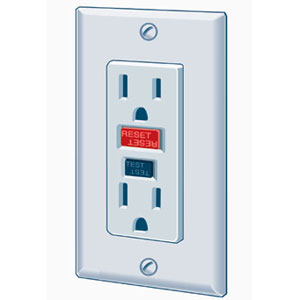
A ground fault circuit interrupter, or GFCI, is an inexpensive electrical safety device that can protect you and your family members from a serious electric shock. 
Have you ever had an electric shock? While it is an unpleasant experience, it is not usually fatal. However, given the right conditions, the same shock could be fatal! If your body makes a solid connection to the ground, the shock could easily kill you. Here are two examples of a solid ground connection:
- If you are physically standing or touching the ground outside
- If you touch something conductive, such as any part of the plumbing system in your house, that is also touching the ground outside
In other words, if you decide to operate your hedge trimmer in your bare feet and you get a shock, you may not survive it.
How Can a GFCI Help?
A GFCI is a special electrical outlet that prevents electric shocks in situations such as the ones described above. The GFCI monitors the electrical current leaving from and returning to the outlet. The current leaving the outlet should be the same amount as the returning current. If the current returning is less than that which leaves, the missing current could be passing through somebody’s body to the ground. The GFCI detects the mismatch and shuts off the electrical outlet in a split second.
Where Should GFCI Outlets Be Located?
GFCI outlets should be installed in any area that presents a risk of an electric shock with a direct path to the ground. In other words, anywhere you might directly touch the ground outside or anywhere where you might touch a part of the plumbing system. Some smart GFCIs locations are:
- Exterior outlets
- Kitchen counter outlets (not common in Canada)
- Bathroom outlets
- Garage outlets
- Outlets in unfinished basements
This is not a complete list. Areas near swimming pools, hot tubs, and so on should also include this type of outlet.
GFCIs are not perfect, however, and have been known to “nuisance trip” when connected to certain types of electrical equipment. For this reason, exceptions to the suggested (or required) locations for GFCIs exist. For example, a regular outlet would be a better choice for a freezer in your garage since the potential for nuisance tripping of the GCFI is high and might go undetected for days, leading to spoiled food in the shut-off freezer.
Remote GFCI
Several electrical outlets usually connect to a single circuit in an average home. A single GFCI outlet will protect all of the outlets in the circuit, even if the other outlets are not GFCIs. But the GFCI outlet must be the first outlet in the string in order for it to properly protect the other outlets, and, of course the connections have to be properly made.
Remote GFCIs sometimes cause confusion for home owners in the following ways:
- A home owner thinks the bathroom does not have a GFCI because the outlet looks like a standard one. The standard outlet under the protection of a remote GFCI should have a sticker indicating its GFCI protection. The problem is, the sticker does not stick forever. A Pillar To Post® inspector can test this for you.
- A standard outlet that does not appear to work in a bathroom or kitchen may actually be attached to a remote GFCI outlet that has nuisance tripped. Before calling an electrician, check the GFCI outlets in other bathrooms and in other locations around the house.
Testing
GFCIs are easy to test and should be tested every month. Simply press the test button on the outlet. You should hear a pop as the reset button pops out a little. To reset, just press the reset button. If the GFCI fails to trip, or if you are unable to reset it, it is time for an electrician to replace it.
Special breakers also provide GFCI protection to the entire circuit. These breakers can be installed instead of GFCI outlets. The GFCI breaker should also be tested monthly. You will recognize this breaker from the test and reset button.
GFCIs can help prevent injury and death from electric shock. It is a small device worth having to ensure the safety of your family members.

Information that is being provide is for Educational Purpose, Any electric work that is needing to be done, should be done by a Licensed Electrician.
Source: Pillar To Post Information Series
Category:
Educational Purpose| No Comments »
March 16th, 2011
A 40 amp breaker, standard ranges have a three conductor #8 copper wire installed, terminating in a three pole four wire grounding receptacle. NEMA number 14-50R.
Information that is being provide is for Educational Purpose, Any electric work that is needing to be done, should be done by a Licensed Electrician.
Category:
Educational Purpose| No Comments »
March 16th, 2011
The most common type of cable used in houses is technically known as NMD 90 (Non-Metallic Dry service cable rated at maximum of 90 degrees Celsius).
It is usually a plastic white covered cable.
How is Wire Sized?
In Canada and the United States there is a standard by which we measure wire. This standard is the A.W.G. (American Wire Gauge).
The most common size of wire that you will be dealing with is a #14.
Wire sizes start at higher numbers such as #24 (small wire) and as the number decreases in value the wire increases in size. The largest wire you will likely need is a #3 gauge. This would be for your incoming service.
The following chart identifies wire/amperage/breaker sizes:
| Wire Size |
Rating (Amperage) |
Breaker Size (Amps) |
| #14 |
15 A. |
15 A. |
| #12 |
20 A. |
20 A. |
| #10 |
30 A. |
30 A. |
| #8 |
45 A. |
40 A. |
| #6 |
65 A. |
60 A. |
| #3 |
105 A. |
100 A. |
*All sizes are a maximum value and in accordance with the Canadian Electrical Code.
Types of Wire
Wire can be either solid of stranded. Most wiring you do in your home will be with solid wire.
Solid wire is easier to work with and takes less time to install. You will find stranded wire in extension cords and any wire gauge over a #10.
Most Commonly Used Cables and Their Uses
2-conductor #14
Plugs, Switched, Lights ,( approx 70 % of your house wiring)
3-conductor #14
3- way Switches, Split Receptacles
2-conductor #12
Selected Heaters , Air Compressors, etc. (anything that uses a maximum of 20 amps)
Kitchen Receptacles circuits (as per the new provisions in the Canadian Electrical Code)
3-conductor #10
- any device that requires a maximum of 30 amps (the most common application would be your electric dryer)
3-conductor #8
- maximum of 40 amps (the most common application would be your electric range)
Information that is being provide is for Educational Purpose, Any electric work that is needing to be done, should be done by a Licensed Electrician.
Category:
Educational Purpose| No Comments »
|
| |
|
|